
The Chinese Renminbi: An Overview for Importers
Understanding CNY and CNH, the managed float, hedging tools, Hong Kong's role as an offshore RMB hub, and what currency movement means for your landed cost when importing from China.
If you import food ingredients from China, the Renminbi is not just a number in a contract. It is a variable that can shift your landed cost by several percentage points between order placement and payment — and the rules governing how it moves, who controls it, and how you can manage your exposure are considerably more interesting than most importers realise.
The Renminbi (人民幣, RMB) — literally "the people's currency" — has been China's official currency since 1948, issued by the People's Bank of China (PBOC). The Yuan (元) is its primary unit. Since the 1978 economic reforms, China has evolved from a closed planned economy to the world's second-largest by GDP, and the RMB's role in global trade has evolved with it. Understanding how it works is basic commercial literacy for anyone buying from China.
Two Markets, One Currency: CNY and CNH
The RMB operates as two distinct markets, and the distinction matters practically for importers.
- Traded within mainland China
- Regulated by PBOC and SAFE
- Daily reference rate set each morning
- Subject to capital controls — limited convertibility
- Used for direct payments to mainland suppliers via CIPS
- ISO code: CNY
- Traded outside mainland China
- Introduced in 2010 — primarily in Hong Kong
- Freely convertible; greater flexibility
- Can be held, traded, and used for offshore payments without capital controls
- Used for offshore hedging, dim sum bonds, CNH forwards
- ISO code: CNH
CNY and CNH exchange at a 1:1 ratio within China — but their rates against third currencies (USD, EUR, GBP) can and do diverge. During periods of currency stress, the CNH/USD spread can widen meaningfully. Importers contracting in CNY and converting from another currency need to know which rate applies to their specific transaction.
A Historical Note: Foreign Exchange Certificates (1980–1994)
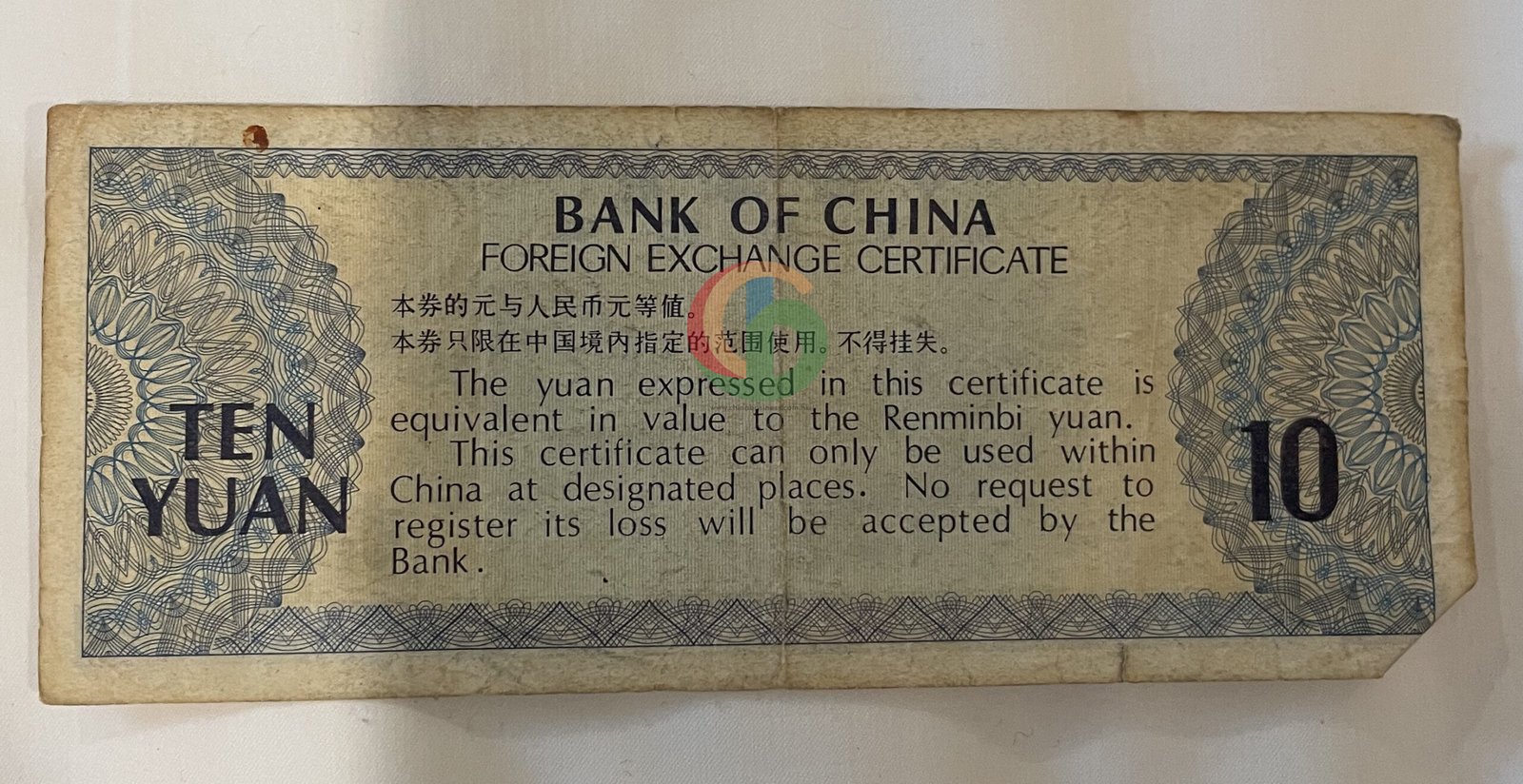 A 10-Yuan Foreign Exchange Certificate (FEC) — used in China from 1980 to 1994.
Foreign Exchange Certificates
From 1980 to 1994, China operated a parallel currency system for foreign visitors and businesses: Foreign Exchange Certificates (FEC), issued by the Bank of China. FECs were pegged to the RMB but used in designated hotels, shops, and for foreign transactions — with exchange rates ranging from US$1 = ¥2.8 FEC to ¥5.5 FEC over the period.
CBL was established in 1991 — in the middle of the FEC era. Anyone conducting China business in the early 1990s was navigating this dual-currency system as a daily reality. FECs were phased out in 1994 when China unified its exchange rate and abolished the dual system.
For today's importers, FECs are a historical footnote — but they illustrate China's path of gradual, managed economic liberalisation, which continues to shape the RMB's partial convertibility today.
How the RMB is Managed: The PBOC Daily Fix
The Renminbi is neither freely floating nor fully fixed. It operates under what the PBOC calls a managed float with reference to a basket of currencies — a description that covers considerable active management.
Each trading day, the PBOC sets a "central parity rate" — the official mid-rate — for CNY against the USD. The currency is then permitted to trade within a ±2% band around that central rate during the session. The reference basket includes USD, EUR, JPY, GBP, and others, weighted by China's trade relationships. When the PBOC sets a stronger-than-market fixing, it is a clear signal of support for the currency. A weaker fixing signals tolerance for depreciation.
The signal to watch: The daily PBOC central parity rate is published each morning. Tracking whether it is consistently stronger or weaker than the previous close tells you more about currency direction than any analyst commentary.
Historical Exchange Rates: USD/CNY — Selected Years
The RMB's rate against the USD tells the story of China's economic opening. The table below shows approximate annual average rates for selected years, covering the key phases of policy change. All figures are approximate annual averages.
| Year | Approx. USD/CNY | Key Event / Context |
|---|---|---|
| 1985 | 2.94 | Early reform era — controlled rate |
| 1990 | 4.78 | Gradual depreciation through reform period |
| 1994 | 8.62 | Major devaluation — dual-rate system unified; FECs abolished |
| 1997–2004 | ~8.27 | De facto peg to USD — stable through Asian crisis and beyond |
| 2005 | 8.19 | Managed float reform begins — gradual appreciation starts |
| 2008 | 6.95 | Appreciation paused during global financial crisis |
| 2013 | 6.19 | Peak of the appreciation cycle |
| 2015 | 6.49 | Shock devaluation — PBOC adjusts central parity mechanism (August 2015) |
| 2018 | 6.62 | US-China trade war pressures |
| 2020 | 6.90 | Pandemic year |
| 2022 | 6.74 | Post-COVID recovery |
| 2023 | 7.08 | US-China interest rate differential pressure |
| 2024 | ~7.18 | Continued depreciation pressure; PBOC defensive management |
| Approximate annual averages. Verify current rates with real-time sources before making decisions. | ||
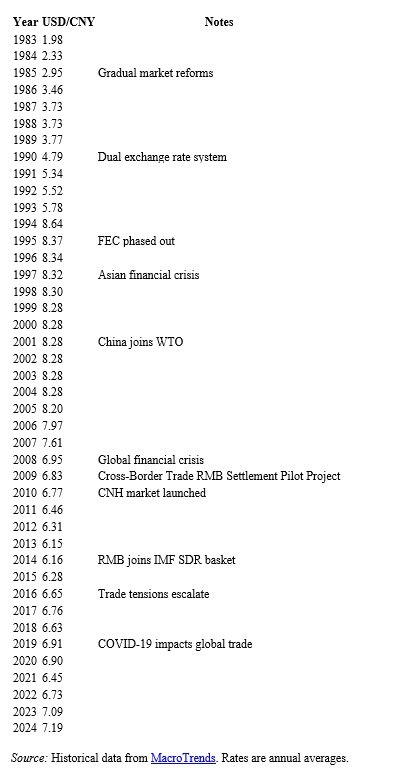 CNY/USD long-term exchange rate. Source: CBL research compilation.
Hedging RMB Risk: Non-Deliverable Forwards (NDFs)
Currency fluctuations can shift import costs materially. For importers with significant CNY exposure, Non-Deliverable Forwards (NDFs) are the primary hedging instrument — particularly useful because CNY is not fully convertible, making standard deliverable forwards difficult to access.
An NDF is a forward contract settled in USD: at maturity, the difference between the agreed forward rate and the prevailing spot rate is settled in cash. No physical RMB changes hands. This allows an importer to effectively lock in a future USD/CNY rate, removing uncertainty from long-term contracts or recurring payment streams.
CNH deliverable forwards are available for offshore (CNH) exposure and tend to be more volatile than CNY NDFs, since CNH tracks market sentiment more freely. For most food ingredient importers dealing with supplier invoices in USD or CNY, the practical question is simpler: when is the invoice due, and what rate do you use for your costing? Build a 3–5% currency buffer into CNY-denominated costings and review it each contract cycle.
Hong Kong's Role as the Offshore RMB Hub
China Business Limited is based in Hong Kong — and Hong Kong's position in the RMB system is directly relevant to how we facilitate transactions. Hong Kong accounts for approximately 70% of global offshore RMB trading, making it by far the largest CNH market in the world.
CNH Deposits
From ¥90bn in 2010 to ¥1.5 trillion by 2014 — Hong Kong built the offshore RMB infrastructure that the rest of the world uses.
Trade Settlement
Since 2009, Hong Kong has facilitated direct RMB trade settlement — suppliers paid in CNH, convertible to CNY at 1:1.
Financial Products
Dim sum bonds, CNH forwards, options — the hedging tools available to importers operating through HK.
HKD Stability
HKD pegged to USD since 1983 (7.75–7.85 band). Provides a stable bridge currency for Hong Kong-based transactions.
Clearing Centre
Hong Kong handles ~83% of global RMB payments — the HKMA and PBOC bilateral swap arrangements underpin this.
CIPS Access
Cross-Border Interbank Payments System — direct CNY payment infrastructure, accessible via Hong Kong-based banks.
Payment Terms and Currency Risk in Food Ingredient Contracts
Most Chinese food ingredient export contracts are denominated in USD — which places the CNY conversion risk on the supplier, who adjusts future quotations to reflect rate changes (usually with a lag). When contracts are quoted in CNY, the buyer carries the currency risk.
| Payment Structure | Currency Risk Timing | Notes |
|---|---|---|
| TT 30/70 (Telegraphic Transfer) | At deposit AND at balance payment | Two separate currency exposures. Common for established suppliers, smaller volumes. |
| Letter of Credit (LC at sight) | Effectively fixed at LC opening | Rate locked when LC is opened. Standard for larger or first transactions. |
| Open account / DA / DP | At maturity — exposure from shipment to payment | Used with established relationships only. Rate exposure can be 30–90 days. |
Practical Tips for Importers
Exchange rate data and historical figures in this post are approximate annual averages for informational purposes only. They should be verified with real-time sources before use in financial or commercial decisions. This post does not constitute financial advice. Consult a qualified financial adviser for guidance on currency hedging and risk management strategies appropriate to your specific situation. China Business Limited accepts no liability arising from use of this information.
Importing food ingredients from China? We work with buyers across 60+ countries and understand the currency, payment, and logistics realities of China-origin sourcing.
Talk to Us