
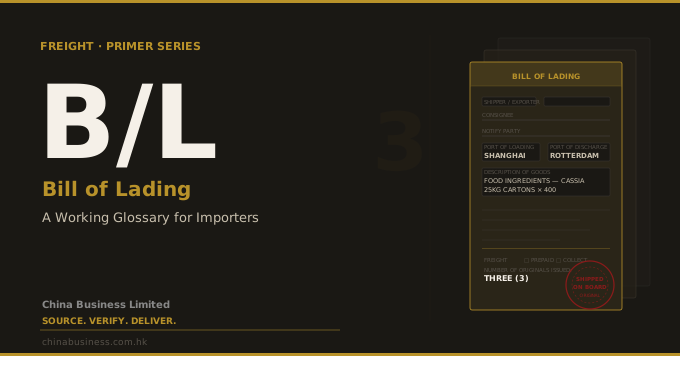
Bill of Lading — A Working Glossary for Importers
⚠ Scope: This post covers Bills of Lading for containerised (FCL/LCL) ocean shipments only. Charter party B/Ls, tanker bills, conventional breakbulk cargo, and other specialised shipping arrangements operate under different rules and are not covered here.
A Bill of Lading is the most important document in ocean freight — yet the terminology is routinely misunderstood, and the distinctions have real commercial and legal consequences. This primer covers the key terms, types, and traps, in a sequence that builds logically rather than alphabetically.
Understanding this saves you time in negotiations and avoids misunderstandings with your supplier, freight forwarder, or bank. It is not a substitute for professional advice — but it means you know what questions to ask.
Think of a Bill of Lading (B/L) as doing three things simultaneously: it is a receipt for goods, a contract of carriage between shipper and carrier, and — when it is a negotiable original — a document of title that controls who can take delivery. The same piece of paper. Three functions. The problems arise when parties treat it as just one of the three.
Quick Reference — All Key Terms
| Abbreviation / Term | Full Name | What It Is | Key Point / When Used |
|---|---|---|---|
| B/L | Bill of Lading | The master shipping document | Receipt + contract of carriage + document of title — all three in one |
| OBL | Original Bill of Lading | The physical original(s) | Typically issued as a set of three; any one is sufficient for delivery |
| MBL | Master Bill of Lading | B/L issued by the shipping line direct | Cargo owner has direct contract with carrier — lower risk |
| HBL | House Bill of Lading | B/L issued by a freight forwarder | MBL runs in parallel to carrier; cargo owner only sees the HBL |
| POL | Port of Loading | Where goods go onto the ship | THC charged here; vessel departs from POL |
| POD | Port of Discharge | Where goods come off the ship | THC charged here again; D/O collected at POD |
| THC | Terminal Handling Charge | Port terminal fee for moving containers | Levied at both POL and POD; always confirm what is included in freight quotes |
| D/O | Delivery Order | Carrier's instruction to terminal to release cargo | Consignee presents OBL (or telex release proof) to carrier's agent to obtain D/O |
| Received for Shipment B/L | — | Confirms cargo received — not yet sailed | Not acceptable under most LCs without an on-board notation added |
| Shipped On-Board B/L | — | Confirms goods loaded and vessel has departed | Standard requirement for Letters of Credit and bank documentary collections |
| Clean B/L | — | No adverse remarks on face of B/L | Required by banks for documentary credit; any deficiency remark makes it claused |
| Claused B/L | Foul / Dirty B/L | Carries remarks noting packaging defects or shortages | Red flag — typically rejected by consignee's bank under an LC |
| Negotiable B/L | — | Consignee field shows "TO ORDER" — can be endorsed | Required for LC transactions; goods pledged to banks; re-sale in transit |
| N/N B/L | Non-Negotiable (Straight) B/L | Named consignee only — cannot be endorsed or transferred | Cannot be exchanged for a D/O nor transferred to another holder |
| SWB | Sea Waybill | Non-negotiable; no original required at destination | Established relationships; no bank financing — not suitable where goods are pledged |
| Telex Release | — | OBLs surrendered at origin; carrier notifies destination electronically | Converts an OBL arrangement to waybill-style release after the fact |
| CT-B/L | Combined Transport B/L | Covers multiple transport modes under one document | Place of Receipt ≠ Port of Loading, or POD ≠ Place of Delivery — read carefully |
| NVOCC | Non-Vessel Operating Common Carrier | Issues B/Ls but does not own or operate ships | Must hold NVOCC licence; request proof before entrusting your shipment |
| FIATA | International Federation of Freight Forwarders Associations | Global professional body for freight forwarders | Membership is a credibility marker — request proof of current membership |
1. Who Issues Your B/L? MBL vs HBL
Every ocean shipment generates at least one B/L. Whether it generates two — and what that means for you — depends on whether a freight forwarder is in the chain.
If you have contracted directly with the shipping line, the line issues you an MBL. The cargo owner (shipper or consignee) has a direct contractual relationship with the carrier. This is the simpler, lower-risk arrangement.
When a forwarder is involved, there are two parallel documents running simultaneously: the HBL (forwarder to cargo owner) and the MBL (carrier to forwarder). The cargo owner sees only the HBL. The MBL is a separate contract between the forwarder and the carrier — one the cargo owner is not a party to.
This matters because the HBL is only as good as the forwarder standing behind it. The table below summarises the key risks:
| Risk | What Can Go Wrong |
|---|---|
| Freight not paid to carrier | If the forwarder collects freight from you but fails to pay the carrier, the carrier may refuse to release cargo at destination — regardless of what your HBL says. |
| Double charges | Forwarder documentation fees are often charged on top of the carrier's own doc fees — at both POL and POD. |
| Double D/O procedure | At destination, you may need to collect a Delivery Order from the forwarder and then a second D/O from the carrier before the terminal releases your cargo. |
| HBL / MBL mismatch | If the HBL details (description, quantities, marks) are inconsistent with the MBL, customs clearance at destination can be refused or delayed. |
| No recourse at either end | Some forwarders are incorporated offshore with no physical presence at POL or POD. In the event of financial failure or fraud, you have no one to pursue. |
2. What Stage Are Your Goods At? — Two Critical B/L Types
A B/L issued too early can create a false sense of security. The distinction between these two is not administrative — it is evidence of whether your goods have actually left.
Confirms the carrier has received the cargo for loading. It does not confirm the goods have sailed. The vessel may not have departed. There may be delays, rollovers, or equipment changes. Banks requiring a "shipped on board" endorsement for an LC will not accept this B/L as-is.
Contains a specific notation — "Shipped On Board" — confirming that the goods have been loaded onto the named vessel and that vessel has departed POL. This is the standard requirement under most Letters of Credit and bank documentary collections. If a B/L does not carry this notation, push back before accepting it.
3. What is the Condition of Your Cargo? — Clean vs Claused
A B/L with no adverse remarks on its face — no notations about damaged packaging, short counts, wet cartons, or any other deficiency observed at the time of loading. Banks almost universally require a clean B/L for documentary credit transactions.
A B/L that carries remarks noting a deficiency — e.g. "2 cartons damaged," "packaging torn," "short-shipped." A claused B/L is a red flag for the consignee and will typically be rejected by the consignee's bank under an LC.
4. Can Your B/L Be Transferred? — Negotiability
This is the most misunderstood area of B/L terminology. "Negotiable" has nothing to do with price negotiation. It refers to whether the document of title (and therefore the goods) can be transferred from one party to another while cargo is at sea.
A B/L is negotiable when the consignee field reads "TO ORDER", "TO ORDER OF [Shipper]", or "TO ORDER OF [named party]". Ownership of the goods can be transferred by endorsement — the holder signs on the reverse and names the next party. This chain of endorsements is what makes international trade finance possible: goods can be sold, pledged to a bank, or re-sold in transit.
A typical endorsement chain for a documentary credit transaction looks like this:
A B/L issued to a named consignee with no "TO ORDER" language. An N/N B/L cannot be exchanged for a Delivery Order, nor can it be transferred to another holder. Commonly used for intercompany shipments or established buyer-seller relationships where no bank financing is involved.
5. When No Original B/L is Needed — SWB and Telex Release
A Sea Waybill is a non-negotiable transport document. Unlike an OBL, it does not need to be physically presented at destination to release cargo. The carrier sends a confirmation to their destination agent, and the named consignee collects against proof of identity. Convenient for established trading relationships — eliminates courier fees and the risk of original documents being lost in transit. Not suitable where the goods are pledged to a bank or need to be sold in transit.
An arrangement available for shipments where OBLs were originally issued. The shipper surrenders the full set of original B/Ls at the port of loading. The carrier's agent at POL then sends a message (historically a telex; now email or system notification) to their agent at POD, authorising release of the cargo to the consignee without presentation of an original B/L. Effectively converts an OBL arrangement into a waybill-style release after the fact.
6. Multi-Modal Shipments — CT-B/L
Covers a shipment that moves by more than one mode of transport — for example, road to the port, then ocean, then rail at destination. Issued by the party responsible for the through-carriage. Typically shows either a Place of Receipt different from the Port of Loading (first leg handled by a sub-carrier) or a Place of Delivery different from the Port of Discharge (final leg handled by a sub-carrier). Understanding this distinction matters when determining who is responsible for damage occurring on each leg.
7. Originals, Delivery Orders and Charges
Carriers typically issue a set of three original B/Ls — a practice dating from the era of postal delivery, when originals frequently went missing. Any one of the three originals is sufficient to release cargo. Once one original has been used, the others become void. The full set should be kept together and tracked carefully.
The instruction issued by the carrier (or forwarder) to the terminal, authorising release of a specific container to the named consignee or their agent. The consignee typically presents an original B/L (or proof of telex release) to the carrier's agent to obtain the D/O, which is then presented to the terminal. Where an HBL is involved, there may be a two-step process: D/O from forwarder, then D/O from carrier.
A fee charged by the port terminal for handling containers — moving them between vessel and storage yard. THC is levied at both ends of the voyage: at POL (sometimes written THC(L) or THL) and at POD (THC(D) or THD). It is separate from ocean freight and is commonly — but not always — included in all-in freight quotations. Always confirm which charges are included in a freight quote before accepting it.
For more in-depth information — existing customers are welcome to reach us through your usual contact methods. New customers: please use our telephone, fax, or contact form.
We are also pleased to recommend quality specialist lawyers — in Hong Kong, Mainland China, Europe, and elsewhere through our connections — for detailed legal guidance or document review, should that be required. Their services are provided independently and are charged at their standard professional rates.