

Peanut Protein in Dehydrated Garlic: Allergen Risks & Testing Nuances
Why even trace levels of peanut protein demand rigorous quality control — and why powder and flake forms can produce different test results from the same source material.
Why Peanut Protein Matters in Dehydrated Garlic
In an era of heightened allergen awareness and rigorous food safety standards, managing unintended cross-contact is critical for dehydrated garlic manufacturers. Peanut protein is one of the most potent food allergens — even trace levels can provoke severe reactions and trigger costly product recalls, making strict quality control and regulatory compliance non-negotiable.

Dehydrated garlic flakes — quality inspection at our partner Shandong factory
What Major Markets Require
While specific frameworks vary by jurisdiction, the shared goal across all major import markets is to protect consumers through mandatory allergen declaration and minimising inadvertent cross-contact. In practice, manufacturers are expected to maintain peanut protein contamination below the 1–10 ppm range.
| Market | Regulatory Approach | Practical Threshold |
|---|---|---|
| EU | Mandatory declaration of peanut as a major allergen under Regulation 1169/2011 | Typically <10 ppm triggers labelling |
| USA (FDA) | FALCPA requires peanut declaration. No specific numerical limit for dehydrated garlic, but general allergen policy applies | <10 ppm common industry target |
| Japan | Clear regulatory trigger: peanut protein exceeding 10 ppm requires labelling | <10 ppm — manufacturers target well below |
| Australia / NZ | FSANZ requires allergen declaration; precautionary labelling if cross-contact possible | <1–10 ppm depending on risk assessment |
| Israel | Strict allergen labelling requirements; peanut as major allergen | Aligns with EU-level expectations |
Key point: Regardless of the specific numerical threshold, the underlying mandate is consistent across all major markets — employ state-of-the-art cleaning, processing and testing protocols so that any unintended peanut protein is minimised and transparently documented.
Why Powder and Flakes Can Give Different Results
An important analytical observation: garlic powder — produced by milling garlic flakes — sometimes shows detectable peanut protein levels while the original flakes test negative from the same source material. This arises from matrix effects induced by the milling process:
- Grinding increases surface area and homogenises the product, releasing trace allergen residues that may have been bound within the flake structure.
- ELISA extraction methods are more efficient with a fine powder matrix, leading to higher apparent concentrations — even if actual contamination is identical.
- Garlic flake structure can limit the release of bound allergens during extraction, producing undetectable results even where minimal cross-contact occurred.
Peanut vs. Peanut Protein — Why the Test Type Matters
Two commonly specified ELISA test approaches target different things:
- Peanut ELISA: Detects broader antigenic determinants present in whole peanut residues. May use milder extraction, potentially underestimating low-level contamination in complex matrices.
- Peanut Protein ELISA (e.g. targeting Ara h 1, Ara h 2, Ara h 3): Uses antibodies optimised for the specific allergenic protein epitopes. Employs more rigorous extraction — giving sensitive, reproducible quantification of actual protein residues.
When specifying testing, buyers should clearly state which method is required for their target market. Results from the two methods are not directly comparable.
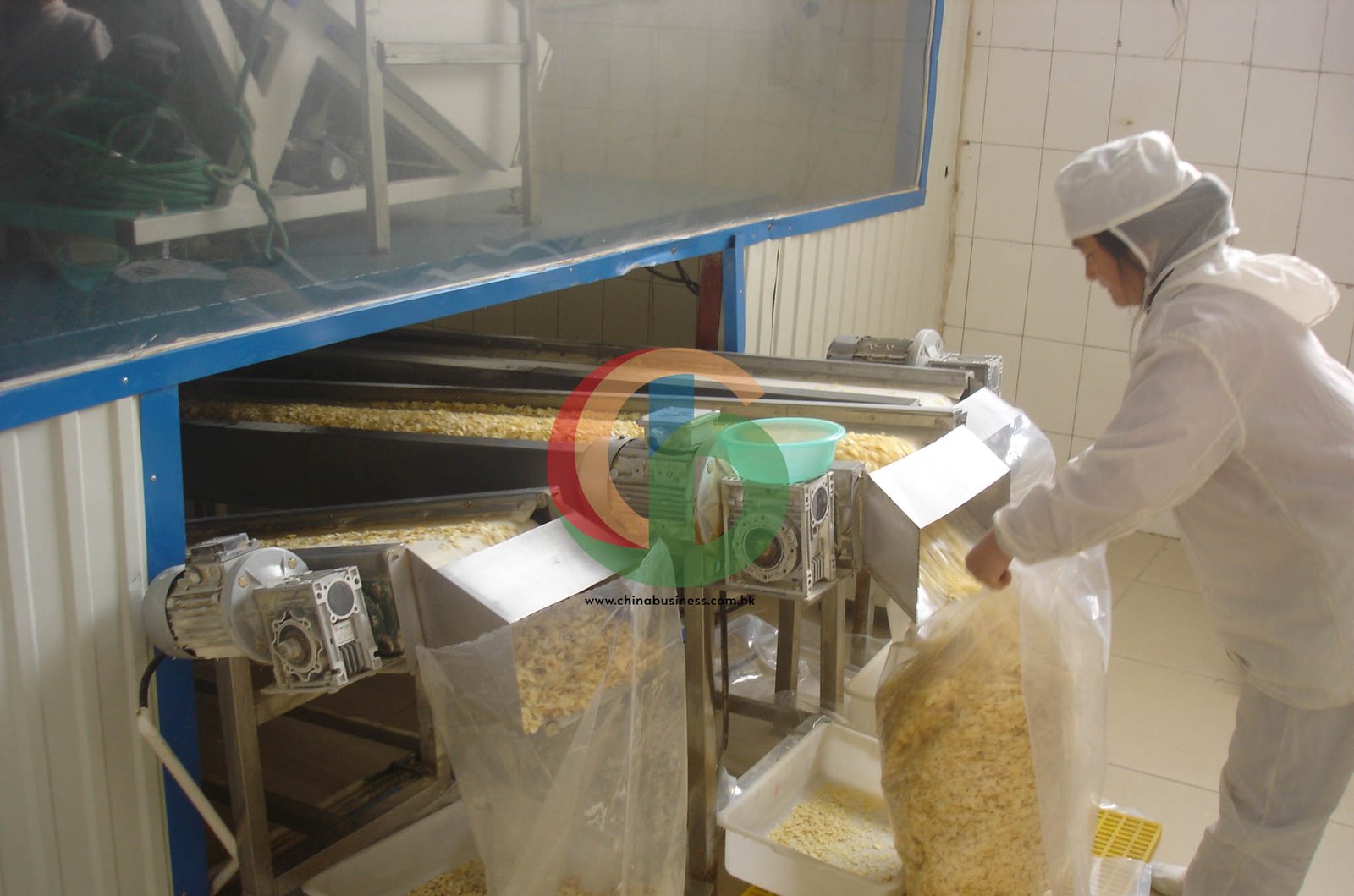
Final packing and pre-shipment inspection — dehydrated garlic
Quality Oversight from Factory to Port
CBL operates as your broker and agent in China — not as a trader. We represent your interests: verifying producers, specifying allergen testing protocols appropriate for your target market, and monitoring every batch against your documented requirements.
Agency: Fixed-fee for audits, testing protocol specification, factory visits.
Brokerage: Commission on completed transaction only. You contract directly with the factory. White label and private label coordinated through this model.
Our Role in the Dehydrated Garlic Supply Chain
We coordinate supplier matchmaking, quality assurance and compliance monitoring in China. We handle peanut protein and full allergen panels, sulphites, pesticide residues, heavy metals and microbiological testing. Available in various sizes, colours, thicknesses — raw, roasted, flakes, granules and powder.
Contact us with your specification for a quote. More details on our Dehydrated Garlic product page.
Need allergen-compliant dehydrated garlic with full documentation for your target market?
We have the supply chain and testing protocols to support you.