
The Spice Trade Doesn't Have Prices.
It Has Weather, Wars, Farmers, and Rumours.
Why buying the right product at the wrong time can cost you more than buying the wrong product at any time — and what 35 years on the ground in Asia actually teaches you about spice market risk.
Most buyers think about price risk the wrong way. They look at today's price, compare it to last year's, and decide whether to buy now or wait. That is not analysis. That is a coin toss with extra steps.
In the spice trade, a price is not a stable number that occasionally moves. It is the temporary equilibrium between at least six forces that are usually pulling in different directions simultaneously — and not one of them cares about your purchase order, your contract terms, or your budget cycle.
The best strategy and the best brand can still lose money if purchasing is timed wrong. Many spice businesses do not succeed or fail on margin — they succeed or fail based on which side of the market they were on. A trader can sell at the same price they paid and still make a profit, simply because the goods they are selling were bought months earlier at a lower price. Or lose everything on goods bought at the top.
To understand why, start with cloves.
I. The Cloves Story: A 50-Year Masterclass in Market Risk
No commodity in our experience illustrates spice market risk more completely than cloves. It has seen government policy disasters, farmer revolts, cartel manipulation, smuggling empires, and price collapses that wiped out entire exporting nations — sometimes all in the same decade.
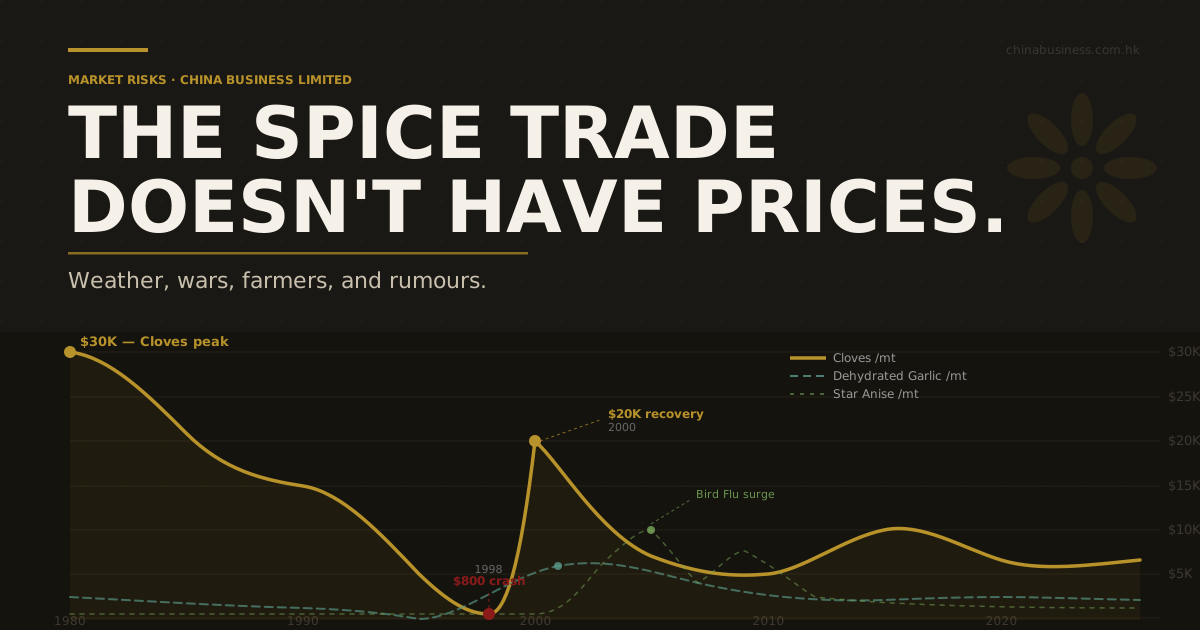
In the late 1970s, cloves were trading at around $30,000 per metric tonne. Indonesia was the world's largest consumer — Indonesians smoke clove-laced kreteks cigarettes the way the British drink tea — and was spending enormous amounts of foreign exchange importing them. The World Bank, in its infinite wisdom, advised Indonesia to solve this problem by growing more of its own cloves. Indonesia listened.
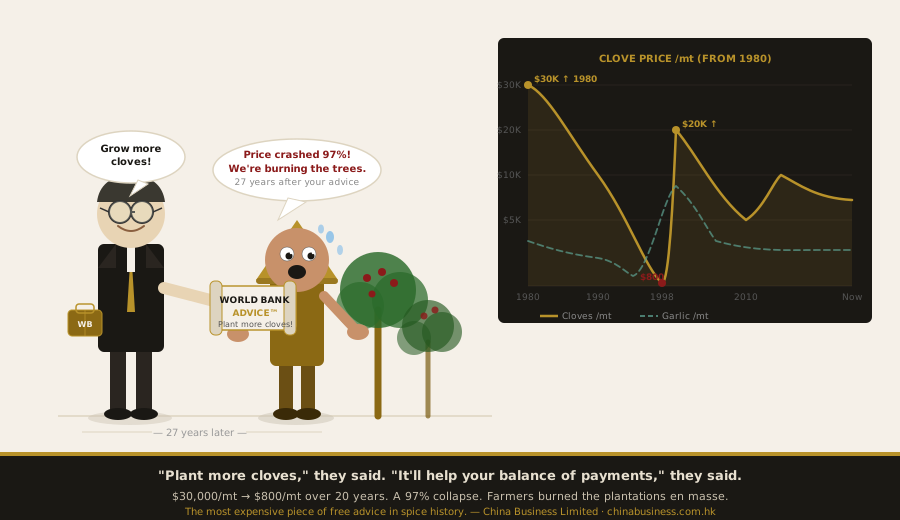 The most expensive piece of free advice in spice history. The World Bank recommended Indonesia grow more cloves in the early 1970s. Price fell from ~$30,000/mt to $800/mt by 1998 — a 97% collapse. Farmers burned the plantations. Within two years, the price had recovered to $20,000/mt.
Indonesia planted. So did everyone else who noticed Indonesia planting. Supply expanded over the following two decades — and the price of cloves fell steadily, remorselessly, to around $800 per metric tonne by 1998. A collapse of over 97%. Farmers who had bet their livelihoods on those trees were financially ruined. Many responded the only way that made sense: they burned their plantations.
Within two years of the burning, clove prices had risen back to $20,000 per metric tonne.
Then down to $3,000. Then up to $10,000. Today, around $7,000.
The cloves story is not an anomaly. It is a template. The same structure — supply expansion, price collapse, supply destruction, violent recovery — repeats across commodities with different actors and different timescales. Vanilla has run this cycle multiple times. So have garlic, cardamom, black pepper, and saffron. Here is why.
II. The Six Forces That Move Spice Prices
1 — The Weather: Acts of God (and El Niño)
Weather is the most honest of the six forces because it has no agenda. Floods, droughts, cyclones, and temperature anomalies driven by El Niño and La Niña reduce or destroy harvests in ways that cannot be gamed, predicted, or priced in with any precision until they are already happening.
- A single cyclone through a producing region can remove 20–40% of a season's crop within 48 hours.
- El Niño-driven drought in Southeast Asia has historically compressed vanilla and pepper yields simultaneously, compounding the price spike across multiple categories.
- The insidious version is prolonged moderate drought — not dramatic enough to make headlines, but quietly cutting yields for two or three seasons before anyone outside the origin country notices.
Weather is the one force where origin intelligence genuinely earns its keep. By the time a weather event appears in trade press, every buyer has already read it. Our value is knowing about developing conditions at farm level — weeks, sometimes months, before they become price-moving news.
2 — The Policy Blunder: When Governments "Help"
The cloves story is the most dramatic example, but government intervention — well-intentioned or otherwise — is a perennial market force. Import and export controls, tariff adjustments, stockpile releases, and subsidised plantation programmes have all moved spice prices significantly, often in the direction opposite to what was intended.
- Export bans during domestic shortages cause artificial price spikes in import markets while simultaneously incentivising smuggling from the exporting country.
- Import duty reductions intended to lower domestic consumer prices can flood a market and destroy the local industry that was supposed to benefit.
- Subsidy programmes that encourage production of a "profitable" crop can, by the time the crop reaches maturity 3–5 years later, have created exactly the glut that eliminates the profitability.
3 — The Herd: Farmers, Seminars, and the Tragedy of the Commons
This one deserves more attention than it usually gets, because it requires no bad actors whatsoever. It is entirely the product of rational individuals making perfectly sensible decisions that collectively produce a catastrophic outcome.
An NGO runs training seminars in a producing region and tells farmers that Commodity X is profitable. The seminars are well-run and the information is true at the time. Farmers in the region — who have historically grown other crops — begin planting Commodity X. They tell their neighbours. Their neighbours tell their neighbours. A regional plantation wave begins.
Three to five years later, when all those trees mature simultaneously, supply floods the market. Prices collapse. The farmers who were told Commodity X was profitable are now producing it at a loss.
No cartel here. No manipulation. No misinformation. Every individual farmer made a perfectly rational choice. The market then punished all of them equally for it.
— The tragedy of the commons, spice edition4 — The Rumour Mill: Misinformation and the Perpetual Shortage
Some market manipulation is deliberate. Buyers and sellers with existing positions have financial incentives to spread information — accurate or not — that moves the market in their favour before they need to execute. This is old, it is universal, and it is not going away.
The more entertaining variant is the structural misinformation that has been circulating for decades without any individual orchestrating it. In our 35 years of business across 60 countries, we have encountered certain suppliers who report a 5–10% crop shortfall for their commodity every single year. We have been hearing this from some of them for three decades.
If the annual 5–10% crop shortage claimed by some suppliers were actually true, the crop would be negative by now. We have done the maths.
— 30 years of the same claimKnowing the difference between a genuine weather-driven shortage and a commercially motivated rumour of one is, frankly, one of the most valuable things an experienced broker can offer. It requires direct relationships with producers, not just with the layer of traders between you and the farm.
5 — The Disease Wildcard: When Medicine Buys Your Dinner Ingredient
This one surprises people every time, despite having a documented history of doing exactly this. A disease outbreak in one part of the world can create demand for a spice ingredient — typically a pharmaceutical precursor or a traditional remedy — that has nothing to do with its culinary use and everything to do with panic buying.
Act I — SARS (2003): Roche's antiviral drug Tamiflu is synthesised from shikimic acid, extracted from Star Anise grown in four provinces of southern China. Guangxi alone produces 85–90% of global supply. When SARS broke out and governments quietly began building Tamiflu stockpiles, Star Anise prices in trade surged — reaching $7,000–10,000 per metric tonne CFR Europe. The public knew nothing about it. The business was thin. But the price had moved.
Act II — H5N1 Bird Flu (2005): This is when Star Anise became a star. International media discovered the Tamiflu-shikimic acid-Star Anise connection. Governments began visibly and urgently stockpiling Tamiflu. China Daily reported prices doubling within a single week in Guangxi. By some estimates, Roche was consuming 90% of the entire world harvest. Shrimp-cooking-spice farmers in rural Guangxi were suddenly fielding calls from pharmaceutical traders across the country. The Washington Post sent a journalist to interview a plantation owner about avian flu.
Act III — H1N1 Swine Flu (2009): China's Health Minister, in a televised press conference, suggested that cooking pork with Star Anise was "a very good option to deal with swine flu." There is no scientific evidence for this. The retail price of Star Anise in Shanghai rose 30% before the week was out. Pharmaceutical shares of shikimic acid producers surged 60% on the Shenzhen bourse. One company — Guilin Layn — saw its shares suspended after it issued a statement saying it had not received a single actual order. The market did not care.
Bonus: During the Bird Flu scare, white vinegar was rumoured to cure the disease. A 20-cent bottle briefly sold for $7 — a 35-fold increase — before the market completely collapsed when the rumour faded. All within days.
Mad Cow Disease (BSE) provides the inverse example: nutmeg and mace prices were depressed for years as markets associated with beef — which uses both as seasonings in processing — contracted sharply. A disease nobody connects to spices can still move spice prices, simply by changing consumption patterns downstream.
6 — Freight and Currency: The Invisible Price on Top of the Price
Even if you get the commodity price exactly right, you can still lose money on a shipment if freight rates or exchange rates move against you between order and delivery. Both have demonstrated the capacity for extraordinary volatility.
Freight: During Covid, container rates from China to European Main Ports rose from approximately $1,000 per TEU to over $20,000 per TEU — a 20-fold increase in under two years. The conflict in the Red Sea, Houthi attacks on shipping, and the resulting rerouting around the Cape of Good Hope repeated this pattern on certain trade lanes, with freight to some Middle Eastern ports rising 5–10 times. Similar disruptions followed the Suez Canal incident, and post-Russia-Ukraine. These are not once-a-generation events. They have occurred multiple times in the past decade alone. See our dedicated post on the Strait of Hormuz freight situation for detail.
Currency: A product priced in USD from a country with a volatile local currency creates compound risk. Suppliers price to cover their local costs — when the local currency weakens, they may absorb the initial shock, but when it strengthens, pressure to reprice in USD comes quickly. The 1997 Asian Financial Crisis restructured sourcing economics across Southeast Asia within months. The Ruble's collapse around the USSR breakdown eliminated purchasing power in entire categories of buyers overnight. The Plaza Accord strengthened the Yen dramatically, making Japanese buyers suddenly expensive and changing trade flows in ways that lasted years. For a dedicated analysis of RMB and what it means for importers specifically, see our post on Chinese Renminbi for Importers.
III. The Numbers in Brief
The forces above are not theoretical. Here are the price swings we have witnessed across commodities in our years of business — all real, all documented, all within living trading memory:
IV. The Hidden Factor: Spices as a Store of Value
Very high-value spices — vanilla, saffron, to some extent high-grade pepper — occupy an unusual double role in some markets. They are simultaneously food ingredients and, informally, stores of value or instruments for moving wealth across borders in jurisdictions with currency controls or political instability.
When a country experiences political upheaval, capital flight, or currency devaluation, the price of certain luxury spices can move for reasons that have nothing to do with culinary demand, harvest conditions, or pharmaceutical use. A buyer paying an unusually high price in one market may be doing so not because they need the spice, but because the spice is a convenient way to transfer value to another jurisdiction.
Understanding whether an unusual price movement in vanilla or saffron is supply-driven, demand-driven, or financially-driven is not always straightforward — and the answer changes what you should do about it.
V. What to Actually Do About It
- The price you see today is not the price. It is a snapshot of a temporarily balanced tension between multiple forces. The relevant question is which of those forces is about to become unbalanced — and in which direction.
- Never confuse a cheap price with a good price. Cheap relative to last year may still be expensive relative to next year. Context matters more than the number.
- Vertical integration of information, not just supply. The buyer who knows what the origin harvest looks like in September will outperform the one who reads the price report in November, every time.
- Check your freight and FX positions as carefully as your commodity position. Winning on the product and losing on the logistics is a category of error that happens more often than people admit.
- Treat the "perpetual shortage" claim as noise until verified. Some shortages are real. Many are not. Knowing the difference requires relationships at farm level, not just with the exporting traders who benefit from the claim being believed.
- Build flexibility into contract terms. Price escalation clauses, origin diversification, and staggered purchasing schedules all reduce the damage when a single force moves against you. None of them are free — but neither is being caught on the wrong side of a market.
- Keep an eye on what diseases are trending. Seriously. The Star Anise story has played out three times now. It will play out again for something, in some spice, at some point. A spice that nobody associates with medicine can become a pharmaceutical raw material priority in a matter of weeks.
Price figures cited in this article are indicative, drawn from CBL's own trading records and publicly available trade sources, and are provided for illustrative purposes only. Past price movements are not indicative of future performance. This article does not constitute financial or trading advice. China Business Limited accepts no liability arising from decisions made on the basis of this content.
We cannot tell you where Garlic will be in six months. Nobody can — and anyone who claims otherwise is selling something other than spices.
What we can tell you is where it has been, why it moved each time, and — based on what we are hearing right now from origin — which direction the pressure is currently building. That context is the difference between a purchase decision and a guess.
35 years · 4 generations · 60 countries · thousands of tonnes annually
Talk to Us