
Coumarin in Cassia and Cinnamon:
What Our Lab Data Actually Shows
Every buyer who sources cassia or cinnamon will eventually face the coumarin question. The published literature cites alarming ranges. Regulations set limits. And the actual numbers from the spice itself vary — sometimes dramatically — by type, origin, and batch. We have tested our own shipments across multiple origins and labs. Here is what we found, and what it means for buyers.
1. What Is Coumarin — and Why Does It Matter?
Coumarin is a naturally occurring benzopyrone — a fragrant compound found in many plants including tonka beans, sweet clover, and members of the cinnamon family. It is not added to spices. It is simply there, produced by the plant itself.
Coumarin was originally used as a flavouring substance in its own right, until a 1954 US ban following evidence of hepatotoxic (liver-damaging) effects in rats and dogs. Since then, adding coumarin directly to food has been prohibited across most major markets. However, its natural occurrence in spice ingredients — particularly cassia — is treated differently: regulators allow cassia and cinnamon to be used as spice ingredients, but set limits on how much coumarin can end up in specific finished food categories as a result.
The 1994 Opinion of the European Commission's Scientific Committee for Food (SCF) — one of the foundational regulatory documents on this subject — was cautious. The Committee concluded that coumarin is a carcinogen in rats and possibly mice via the oral route, and that a genotoxic mechanism could not be excluded at that time. On that basis, it recommended reducing the general limit for coumarin in food to the then-achievable detection limit of 0.5 mg/kg — an extremely conservative position.
By 2004, however, EFSA (the European Food Safety Authority) had reviewed more recent data and reached a different conclusion: coumarin's toxicity in humans is threshold-based (not genotoxic), meaning there is a dose below which harm is not expected. EFSA established a Tolerable Daily Intake (TDI) of 0.1 mg coumarin per kg of body weight per day — equivalent to 6 mg/day for a 60 kg adult. This shift from precautionary prohibition to risk-based management is what gave rise to the current EU framework, which remains in force today.
2. Types — and Why Nomenclature Matters
Cassia and cinnamon are not interchangeable — not commercially, not botanically, and not in terms of coumarin content. In the trade, we use specific names. The following is how China Business Limited refers to each type in all communications, test requests, and commercial documents.
Chinese Cassia
This covers Cassia Whole, Cassia Tube, Cassia Broken, and Cassia Ground — all sourced from China (Cinnamomum cassia). The bark forms are sometimes called Chinese cassia bark in scientific literature. In trade, we call them Chinese Cassia across the board.
Cassia Quills + Country
Quill-style cassia — including what is described in the trade as Cassia Quills, Cassia Scrapped Sticks, and Cigarette Cassia — is referred to by us as Cassia Quills followed by country of origin: Cassia Quills, China; Cassia Quills, Vietnam; and so on. This distinction matters because, as our data shows, the coumarin content can differ very significantly between origins within this form.
Cassia Vera (Indonesia)
Indonesian cassia — sold under grade names including VAA, VA, KBBC, and KABC — is referred to in our documents and test reports as Cassia Vera, Indonesia. Cassia Vera is botanically Cinnamomum burmannii, also known as Korintjie cassia in some markets.
Cinnamon (Sri Lanka)
True cinnamon — Cinnamomum verum, also referred to as Ceylon cinnamon — sourced from Sri Lanka is referred to simply as Cinnamon, Sri Lanka. In scientific and regulatory literature this is sometimes called "true cinnamon" to distinguish it from the cassia group.
3. Our Lab Results
The following data comes from tests commissioned by China Business Limited and associated companies from accredited independent laboratories. The 2025 Eurofins results are from Eurofins Technology Service (Qingdao), testing to Chinese national standard GB 5009.284-2021. The SGS Lanka result is from SGS Lanka (Pvt) Ltd., Colombo. The Spices Board data is from the Spices Board of India, Kochi.
| Product (CBL Nomenclature) | Coumarin (mg/kg) | Lab | Date |
|---|---|---|---|
| Chinese Cassia — Ground | 240 | Eurofins, Qingdao | Jan 2025 |
| Cassia Quills, China | 100 | Eurofins, Qingdao | Jan 2025 |
| Chinese Cassia Whole | 131.5 | Spices Board, India | Nov 2019 |
| Chinese Cassia Scrapped | 84 | Spices Board, India | Nov 2019 |
| Chinese Cassia Whole | 1,600 | Own labs | 2021 |
| Cassia Quills, Vietnam | 1,896.5 | Spices Board, India | Nov 2019 |
| Cassia Pressed, Vietnam | 543.5 | Spices Board, India | Nov 2019 |
| Cassia Quills, Vietnam | 3,500 | Own labs | 2021 |
| Cassia Vera, Indonesia (VAA grade) | 637.91 | Spices Board, India | Nov 2019 |
| Cassia Vera, Indonesia (Korintjie grade) | 139.93 | Spices Board, India | Nov 2019 |
| Cassia Vera, Indonesia (VAA grade) | 5,400 | Own labs | 2021 |
| Cassia Vera, Indonesia (VA grade) | 3,400 | Own labs | 2021 |
| Chinese Cassia Buds | 182.5 | Spices Board, India | Nov 2019 |
| Cinnamon, Sri Lanka (Organic) | Not Detected (LOD: 1 mg/kg) | SGS Lanka, Colombo | Feb 2024 |
| Cinnamon, Sri Lanka | 102 | Spices Board, India | Nov 2019 |
4. Why Our Chinese Cassia Tests Lower — and Why That Is Not a Coincidence
Chinese Cassia is our speciality. It is where we have spent the most time, built the deepest supplier relationships, and learned the most about how coumarin levels are actually determined. Our results consistently sit at the lower end of — and often well below — the ranges cited in published literature. This does not happen by accident.
The commonly cited figures of 1,500 to 9,900 mg/kg for cassia reflect the entire market — all origins within China, all grades, all processing standards, purchased from all kinds of suppliers. Our Chinese Cassia is not the entire market. It is a carefully selected slice of it, and the coumarin numbers reflect that.
Origin within China
China is a vast country with cassia production spread across multiple provinces and sub-regions, each with different soil profiles, climate conditions, and tree varieties. Coumarin content varies significantly between these producing areas — not just between countries. Published averages do not distinguish between them. We source from specific producing areas with documented track records for the quality characteristics we require. The region is part of our sourcing knowledge and we do not publish it, but the test results speak for themselves.
Raw material selection
Our suppliers and we apply selection criteria that go beyond visual grade. Bark thickness, tree maturity, and harvest timing all influence the chemical profile of the finished spice. Younger bark from properly managed trees tends to yield a different profile than older bark harvested without selection. Coumarin is a secondary metabolite — a compound the plant produces in response to various conditions. Its concentration is not fixed; it is managed, at least in part, by how the raw material is chosen.
Processing
Post-harvest handling matters. Drying methods, curing duration, storage conditions, and the speed of processing from harvest to finished product all affect what ends up on a test report. Our suppliers follow specific protocols that have been refined over years of working with buyers who test every shipment. Sloppy processing by commodity suppliers is one reason the general market shows such wide ranges. Consistent processing by quality-focused suppliers is one reason our results cluster at the lower end.
5. How Our Data Compares to Published Ranges
The most widely cited figure in scientific and regulatory literature is that cassia — as a category — contains coumarin in the range of approximately 1,000 to 9,000+ mg/kg, with ground cassia commonly cited at around 3,000 mg/kg average. Cinnamon from Sri Lanka is described as containing only trace amounts, typically below 100 mg/kg and often undetectable.
Our own data tells a more differentiated story.
Chinese Cassia — consistently lower than commonly cited
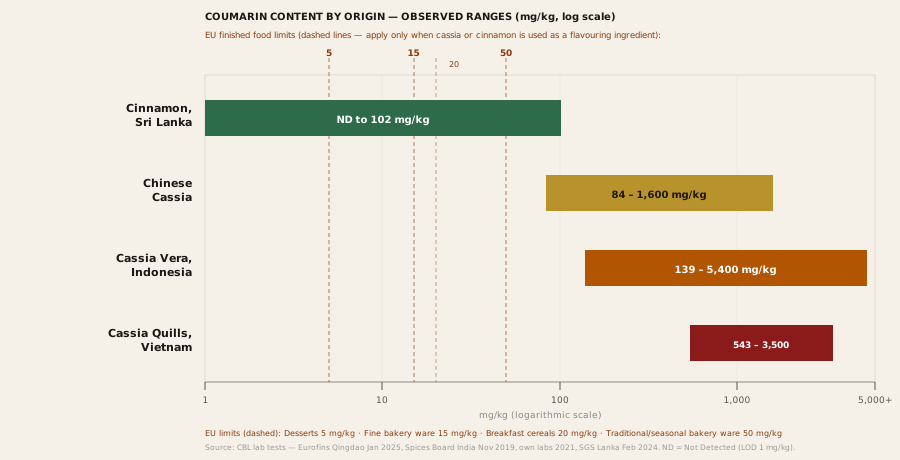
Our most recent tested batches of Chinese Cassia Ground and Cassia Quills, China (Eurofins, January 2025) came in at 240 mg/kg and 100 mg/kg respectively — well below the figures cited in literature. Chinese Cassia Whole and Scrapped from the Spices Board 2019 tests also showed results in the 84 to 131 mg/kg range. An earlier batch from our own labs registered 1,600 mg/kg, showing that variation does occur. The range we observe for Chinese Cassia runs from approximately 84 to 1,600 mg/kg — materially lower than the often-cited 3,000 mg/kg average. As discussed in Section 4, this reflects deliberate sourcing and supply chain management rather than statistical chance.
Cassia Quills, Vietnam — among the highest observed
Cassia from Vietnam, particularly in the Cigarette and Pressed quill styles, shows some of the highest coumarin levels in our dataset. The Cigarette style tested at 1,896.5 mg/kg (Spices Board 2019) and a separate batch from our own labs reached 3,500 mg/kg. This aligns with — and in some cases exceeds — the upper ranges cited in scientific literature for Saigon/Vietnamese cassia, which is generally recognised as having higher coumarin content than Chinese or Indonesian types.
Cassia Vera, Indonesia — the widest range of all
Indonesian Cassia Vera shows perhaps the greatest variability in our dataset. The Korintjie grade tested at 139.93 mg/kg (Spices Board 2019), while VAA-grade from the same test came in at 637.91 mg/kg. Earlier batches from our own labs showed VAA reaching 5,400 mg/kg and VA at 3,400 mg/kg. This four-hundred-fold range across different grades and batches underlines why origin and grade specification alone is not sufficient — buyers importing Cassia Vera for use in finished food products should commission batch-specific testing, particularly for EU-regulated applications.
Cinnamon, Sri Lanka — generally very low, occasionally detectable
The 2024 SGS Lanka test on organic Cinnamon, Sri Lanka found coumarin below the detection limit of 1 mg/kg — consistent with the scientific consensus that Sri Lanka cinnamon contains only trace amounts. A 2019 Spices Board India test on a different Sri Lanka cinnamon sample did register 102 mg/kg, however. This is an agricultural product and batch-to-batch variation is expected. The 2024 SGS result is our most recent primary-source data, and Not Detected at a 1 mg/kg LOD is the result we would report for compliance purposes on that specific batch. Buyers should test each shipment independently.
6. What Regulators Say
European Union — Regulation (EC) No 1334/2008
Coumarin limits in the EU apply only to specific finished food categories where cassia or cinnamon is used as a flavouring ingredient. They do not apply to pure cassia or cinnamon sold as a spice on its own. The limits (as consumed) are:
- Traditional and seasonal bakery ware labelled as containing cinnamon (e.g., cinnamon stars, speculaas): 50 mg/kg
- Breakfast cereals including muesli: 20 mg/kg
- Fine bakery ware (other than the traditional/seasonal category): 15 mg/kg
- Desserts: 5 mg/kg
These limits reflect EFSA's 2004 TDI of 0.1 mg coumarin/kg bodyweight/day. Coumarin may not be added as such — it must arrive only via natural spice ingredients.
United Kingdom — Post-Brexit
The UK retained EU Regulation 1334/2008 as domestic law following Brexit. The same maximum levels apply to finished food categories. UK FSA exposure surveys have found average dietary intake well below the TDI across most population groups. No divergence from EU coumarin rules is currently in place.
United States — FDA
The FDA banned the direct addition of coumarin as a food ingredient in 1954 (21 CFR 189.130). However, naturally occurring coumarin in cassia and cinnamon used as spice ingredients is not subject to specific limits. There is no TDI-based framework equivalent to the EU's for finished food products. General food safety requirements under the FD&C Act apply. Routine coumarin testing of finished products is not federally mandated in the US.
7. What This Means for Buyers
Several practical conclusions follow from the data above.
First, not all Chinese Cassia is alike. The widely cited 3,000 mg/kg average masks an enormous range within China alone — from below 100 mg/kg in well-sourced, well-processed product to well over 1,000 mg/kg in commodity grades. Buyers who rely on published averages rather than actual test data from the specific supplier and batch they are purchasing are working with the wrong numbers. Our results demonstrate what is achievable when origin selection, raw material quality, and processing discipline are applied consistently.
Second, the type distinction between the broader cassia family matters enormously. Cassia Vera (VAA grade) from Indonesia and Cassia Quills from Vietnam routinely test at levels multiples higher than our Chinese Cassia across all our data points. Buyers substituting one cassia type for another on price without adjusting their coumarin calculations take on real compliance risk, particularly for EU and UK finished food applications.
Third, Cinnamon from Sri Lanka remains by far the lowest-coumarin option in the cinnamon family. For manufacturers targeting EU or UK markets with heavily cinnamon-flavoured finished products — breakfast cereals, desserts, infant food applications — Sri Lanka Cinnamon is the most straightforward route to staying within limits without reducing flavour impact. Our SGS Lanka 2024 test showing Not Detected at a 1 mg/kg LOD is the strongest result in our dataset.
Fourth, for the US market, coumarin in cassia is not currently a regulatory constraint — but this does not mean it is invisible. Health-conscious consumers, clean-label commitments, and private retailer specifications increasingly reference coumarin content. Knowing your supply position is commercially valuable even where no legal limit applies.
Finally, the number on a test report reflects a sample from a single batch, tested on a single date. Even with the best sourcing and processing discipline, coumarin content in cassia varies between batches. Robust quality management means testing each shipment. Our suppliers know this because we test — and because consistent results over many years are what makes a long-term sourcing relationship worth having.
China Business Limited sources and verifies cassia and cinnamon from China, Vietnam, Indonesia, and Sri Lanka. If you need coumarin test reports on specific batches, or have questions about compliance for your target market, we are glad to discuss.
Send an Enquiry