
Trade · Buyer's Brief
This guide covers containerised ocean trade only — FCL and LCL. Charter party, tanker, breakbulk and air shipments involve different rules and practices.
Understanding this saves you time in negotiations and avoids misunderstandings with your supplier, freight forwarder, or bank. It is not a substitute for professional advice — but it means you know what questions to ask.
Incoterms® 2020 — eleven rules, one matrix. Here is what purchase managers actually need to know, including the pitfalls that cost money.
The ICC
The International Chamber of Commerce (Paris, est. 1919) is a private-sector body whose members are national chambers of commerce worldwide. It publishes the rules underpinning international trade — including UCP 600 (documentary credits) and Incoterms®. ICC rules carry no force of law; they bind a contract only when explicitly incorporated by reference.
What Incoterms® Are — and Are Not
- Are: standardised rules defining who pays which cost and who carries risk, from seller's premises to buyer's door.
- Are not: payment terms, title-transfer rules, sanctions compliance, or a substitute for a proper sales contract.
- C+F is not an Incoterm — CFR is. Abbreviations must match exactly.
What Changed in Incoterms® 2020
- DAT → DPU: "Delivered at Terminal" renamed "Delivered at Place Unloaded." Scope widened — delivery need not be at a terminal.
- CIP insurance upgraded: now requires ICC(A) — the broadest all-risks clause. Previously ICC(C).
- CIF unchanged: still only requires ICC(C) minimum. Buyers under CIF should consider topping up.
- FCA + "on board" B/L: buyer may now instruct their bank to issue an "on board" bill of lading even though FCA delivery occurs before loading — solving the L/C problem for containerised FCA cargo.
- Ship's rail: already removed in 2010. Risk for FOB / CFR / CIF transfers when goods are "on board the vessel."
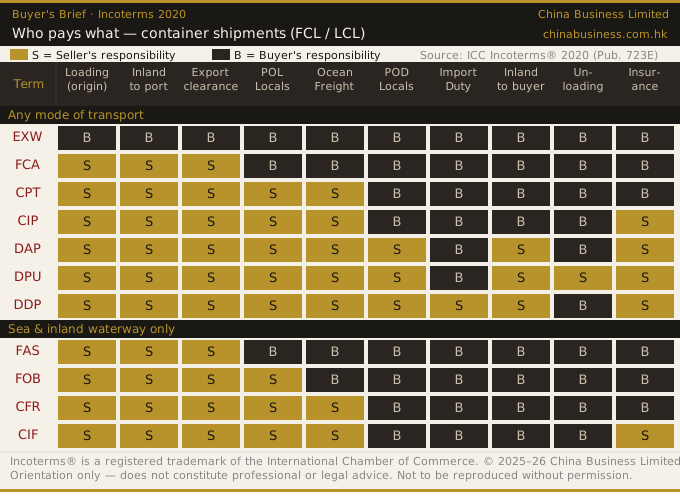
Who Pays What — at a Glance
© 2025–26 China Business Limited · Incoterms® is a registered trademark of the ICC · Not to be reproduced · Not legal advice
The matrix covers every cost element in sequence — loading at origin through to unloading at buyer's premises. S = Seller. B = Buyer. Three points that frequently surprise buyers:
- DAP / DDP: seller pays everything to the door — but buyer still unloads. DDP is not "all done."
- DPU: the one term where seller unloads — but buyer still pays import duty. DPU ≠ DDP.
- CPT / CFR / CIF: seller pays ocean freight, yet risk transfers at origin. Cargo travels at buyer's risk even though seller booked the vessel.
Practical Pitfalls by Term
EXW — Ex Works
Essentially a domestic sale, not an export sale. Complications that follow:
- VAT / GST: local sales attract local tax. Buyer needs an export agent to handle the refund or exemption — otherwise the tax is a real cost buried in the price.
- Currency: in China, India, Indonesia, Vietnam and other major producing countries, factory delivery means payment in local currency. The export agent collects foreign currency and converts — adding another layer to manage.
- Consolidation: buying from multiple suppliers into a single FCL or single B/L? Cross-state or cross-province movement before export can complicate or eliminate VAT refund eligibility.
- We have the expertise and connections to handle all of the above — but advance coordination is essential.
FAS — Free Alongside Ship
- FAS is not FOB. At inland and feeder ports, forwarders often quote a lump-sum covering all local charges plus ocean freight — making the actual handover point invisible in the invoice.
- When your seller says "FOB," verify. They may be delivering FAS and leaving you to cover loading and terminal charges you did not budget for.
FOB — Free On Board
- Under standardised contracts (IGPA, ASTA and others) the buyer must nominate the carrier by a specified deadline. Many ad-hoc contracts omit this deadline — creating disputes when shipment is delayed.
- If buyer nominates a weak carrier — particularly an unlicensed forwarder with no NVOCC registration and no association membership — seller loads cargo against a document of uncertain value. Seller carries the delivery risk.
CFR — Cost and Freight
- Seller pays freight to named port — but risk transfers at origin (same point as FOB). Buyer should always arrange independent insurance; CFR imposes no obligation on either party to insure.
- If buyer does not pay until vessel arrival and has not arranged insurance, a casualty during transit leaves buyer exposed with no recourse on the seller.
CIF — Cost, Insurance and Freight
- Seller provides insurance — but only to ICC(C) minimum: a narrow, named-perils policy.
- Check the insurer. An obscure local insurance company can be very difficult to claim against from another country. A reputable insurer matters as much as the clause.
- Buyers should consider requesting ICC(A) cover or arranging their own top-up policy.
What Exactly Is "Freight"?
The word means different things to different people — and the gap is where disputes begin.
- The lump-sum world: at inland, river and feeder ports, forwarders often quote one all-in number covering local charges and ocean freight. Simple — until something changes.
- The surcharge world: deep-sea carriers typically quote a base rate plus a list of surcharges — BAF (bunker), CAF (currency), GRI (general rate increase), PSS (peak season), war risk, and more. Each is negotiable; each varies by lane and carrier.
- Under Incoterms®, "freight" in CFR and CIF means main carriage only. Destination THC, documentation fees and surcharges are not automatically included. A seller quoting "CIF your port" may not be covering destination terminal charges — the buyer finds out on arrival.
- Rule of thumb: always request an itemised freight quote. If it is one number, ask what is excluded.
For more in-depth information — existing customers are welcome to reach us through your usual contact methods. New customers: please use our telephone, fax, or contact form.
We are also pleased to recommend quality specialist lawyers — in Hong Kong, Mainland China, Europe, and elsewhere through our connections — for detailed legal guidance or document review, should that be required. Their services are provided independently and are charged at their standard professional rates.