
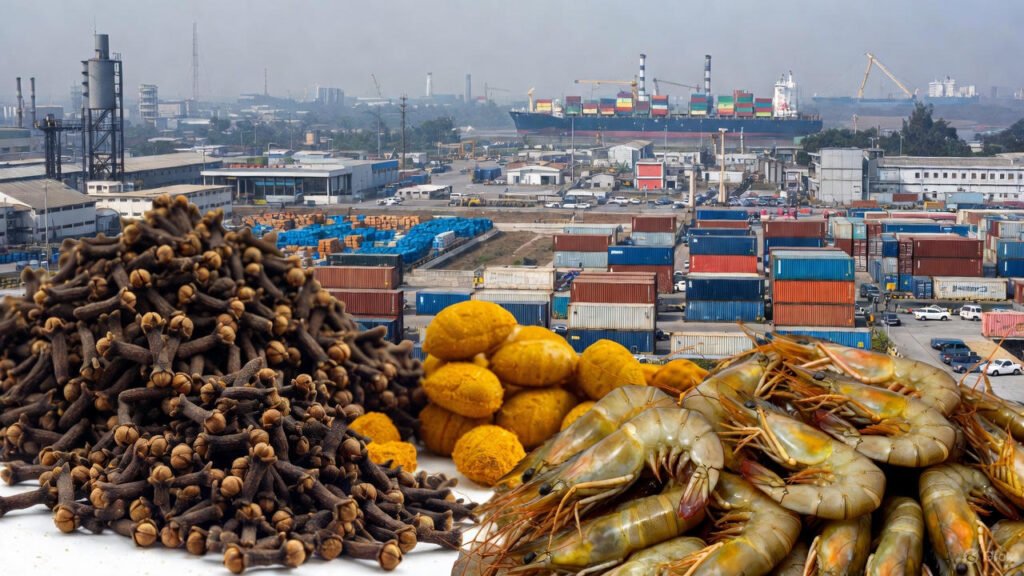
Radioactive Contamination in the Supply Chain: The 2025 Cesium-137 Crisis
How a steel scrapyard in West Java triggered the largest radioactive food recall in US history — and the first-ever use of FSMA import certification authority. A reference guide for importers, distributors, and QC teams sourcing from Indonesia.
China Business Limited does not source products from the affected regions of Indonesia subject to Import Alerts 99-51 and 99-52. We publish this guide because the Cesium-137 crisis has wide implications for any importer sourcing shrimp, cloves, or other spices from Java or Lampung Province — and because the regulatory framework established here sets a precedent that will shape food import compliance for years to come.
Since August 2025, the global food supply chain has faced a landmark disruption involving radioactive Cesium-137 (Cs-137) contamination in food exports from Indonesia. What began with frozen shrimp detected at US ports expanded rapidly to cloves and spices, triggering the largest radioactive food recall in US history and — for the first time ever — the exercise of FSMA's import certification authority under Section 801(q) of the FD&C Act. Every importer and distributor sourcing from the Island of Java or Lampung Province (Sumatra) must act immediately.
1. The Trigger Events: Anatomy of the Contamination
The crisis unfolded in two distinct detection phases, confirming a systemic environmental contamination rather than an isolated product failure.
The Shrimp Recall — August 2025
US Customs and Border Protection (CBP) detected Cs-137 in shipping containers at four US ports simultaneously — Los Angeles, Houston, Savannah, and Miami — alerting the FDA to investigate PT Bahari Makmur Sejati (trading as BMS Foods). FDA laboratory analysis confirmed Cs-137 at 68 Bq/kg in a sample of breaded shrimp. Although this is well below FDA's Derived Intervention Level (DIL) of 1,200 Bq/kg, any artificial radionuclide contamination in food represents a systemic GMP failure. Product had already entered retail channels including Walmart stores across the US under the Great Value private-label brand before the alert was issued.
Multiple distributors initiated recalls in cascade: Southwind Foods (Great American Seafood Imports brand), AquaStar USA (Kroger-branded product — Kroger Raw Colossal EZ Peel Shrimp, Kroger Mercado Cooked Medium Peeled Shrimp), Direct Source Seafood (~83,800 bags sold under Market 32 at Price Chopper and Waterfront Bistro at Jewel-Osco, Albertsons, Safeway, and Lucky Supermarkets). The total volume associated with alerts or recalls exceeded 58 million pounds of shrimp. As of the review date, no product that has tested positive for Cs-137 has been confirmed as having entered the US consumer marketplace.
The Spice Connection — September/October 2025
Following heightened screening, CBP detected Cs-137 in a shipping container at the Port of Los Angeles containing cloves from PT Natural Java Spice. FDA laboratory analysis confirmed 732.43 Bq/kg — below the DIL of 1,200 Bq/kg, but the presence of any artificial radionuclide in spices constitutes a serious GMP breach. The firm was immediately placed on Import Alert 99-51 (Detention Without Physical Examination). The product never entered US commerce. Investigations into whether contamination reached Lampung Province via shared contaminated shipping containers remained ongoing as of the review date.
2. Root Cause: The Cikande Industrial Estate
Indonesian authorities, in conjunction with the FDA and international watchdogs, identified industrial negligence rather than a nuclear accident as the source.
The contamination epicentre was traced to the Cikande Industrial Estate, West Java, approximately 40 miles west of Jakarta. PT Peter Metal Technology, a steel manufacturer that imports scrap metal as its primary raw material, is the suspected culprit. A radioactive source — most likely a discarded industrial density gauge or medical device containing Cs-137 chloride — is believed to have been accidentally smelted with scrap metal. Above its boiling point, cesium chloride becomes a gas, dispersing airborne particles that settle on nearby structures.
BMS Foods' shrimp packaging facility is located approximately 1–2 km from PMT. Airborne Cs-137 particles are believed to have settled on the packaging facility, its equipment, and shipping containers. The Indonesian Environment Ministry confirmed radiation levels in Cikande reached 1,000 microsieverts (100 millirems) — the equivalent of a US worker's annual dose limit in just 50 hours of exposure. Nine individuals were treated for radiation exposure, all in stable condition. The Indonesian government formally cordoned off the Cikande industrial zone and identified 10 discrete Cs-137 contamination sources requiring remediation.
A clove source in Lampung Province, Sumatra was subsequently found with trace radioactivity. Authorities are investigating whether this reflects a separate industrial waste incident in Sumatra or cross-contamination through shipping containers previously used for Java exports. No definitive finding was published as of the review date.
3. Affected Products and HS Codes
Import Alert 99-52 covers all shrimp and all spices from the Island of Java and Lampung Province, Sumatra — regardless of the specific exporter's prior compliance record. Supply chain managers should flag the following HS codes in their ERP systems immediately.
Practical tip for ERP tagging: Set an automated hold flag on any purchase order or import declaration where the Country of Origin is Indonesia AND the HS code falls within Chapter 03 (fish/seafood) or Chapter 09 (spices). Flag for manual review against the Port of Loading on the Bill of Lading — if Java or Lampung, escalate to compliance before payment.
4. Regulatory Framework — A Historic First
⚛ Regulatory MilestoneThis crisis produced a landmark regulatory precedent. On 3 October 2025, the FDA announced Import Alert 99-52, exercising for the first time ever the import certification authority granted by Congress under FSMA Section 801(q) of the Federal Food, Drug, and Cosmetic Act. This authority had existed since 2011 but had never been invoked. Its use here signals that regulators will not hesitate to apply it again.
| Import Alert | Effective Date | Scope | Consequence of Non-Compliance |
|---|---|---|---|
| IA 99-52 — Import Certification (Yellow List) | 31 October 2025 | All shrimp and all spices from Java Island and Lampung Province, regardless of exporter | Detained at port. Release requires valid Import Certificate from FDA-designated Certifying Entity (CE) prior to export from Indonesia |
| IA 99-51 — Detention Without Physical Examination (Red List) | Immediate upon listing | Named firms only — e.g. PT Natural Java Spice | Automatic detention. Importer bears cost of private lab testing to prove each specific lot is clean. Products are NOT eligible for reconditioning |
Note: IA 99-52 was revised on 18 November 2025 to add points of contact for designated Certifying Entities (see Section 5 below).
Key distinction — certification vs. reconditioning: Products detained under Section 801(q) cannot be reconditioned to achieve release. The certification requirement demands comprehensive documentation of manufacturing processes and ingredient sourcing that cannot be satisfied after the fact. This makes pre-shipment certification the only viable route for affected exporters.
5. Certifying Entities — Who Issues the Certificate
The FDA has designated two Indonesian government bodies as the Certifying Entities (CEs) authorised to issue the shipment-specific Import Certificates required under IA 99-52. Contact these bodies before shipment — certification cannot be obtained retrospectively.
Shrimp Certification
Marine Affairs and Fisheries Quality Assurance Agency (MFQAA)
Ministry of Marine Affairs and Fisheries, Republic of Indonesia
Contact: Mochamad Aji Purbayu, DVM, M.S.
mfqaa.idn@kkp.go.idSpice Certification
Indonesia's Food and Drug Authority (BPOM)
Republic of Indonesia
Contact: BPOM Export/Import Division
pangan.exim@pom.go.idThe CE is responsible for screening, sampling, and certifying each shipment. FDA reserves the right to refuse certificates it determines are not valid or reliable.
6. Risk Analysis
The Cikande industrial zone, Cs-137 dispersion pathway, and affected supply chain nodes.
For Consumers — Health Risks
- Bioaccumulation: Cesium-137 mimics potassium biologically. Once ingested, it distributes into soft tissues and muscles rather than bone (unlike Strontium-90).
- Half-life: Cs-137 has a physical half-life of approximately 30 years and a biological half-life of roughly 70 days in the human body — meaning repeated low-dose exposure compounds over time.
- Long-term risk: While immediate radiation sickness is highly unlikely at the levels detected (68 Bq/kg and 732 Bq/kg), chronic consumption below the 1,200 Bq/kg DIL can incrementally raise the statistical risk of DNA damage and solid tumours. The CDC's Agency for Toxic Substances and Disease Registry (ATSDR) confirms this as the primary health concern from prolonged low-dose exposure.
- At the detected levels: US nuclear engineering experts confirmed that levels found in recalled products are "orders of magnitude below" any level that would cause measurable consumer harm. The precautionary recalls reflect regulatory zero-risk policy on artificial radionuclides, not an acute public health emergency.
For Industry — Business Risks
- Port detention and demurrage: Cargo without a valid CE certificate is detained automatically. Daily demurrage at major US ports can reach USD 5,000–10,000 per container, rapidly exceeding cargo value for bulk spice shipments.
- Recall liability: If Cs-137 is detected post-distribution, the cost of a Class I or Class II FDA recall — including mandatory notification, reverse logistics, and disposal — falls entirely on the importer of record.
- Supply disruption: The sweeping geographic scope of IA 99-52 (all products, all exporters from Java and Lampung) has caused significant supply disruption even for exporters with no prior compliance issues. Importers who had pre-purchased inventory at pre-alert prices faced both product holds and higher replacement costs.
- Brand damage: Association with "radioactive food" — even at trace levels — carries disproportionate reputational risk. Retailer relationships and B2C brand equity are particularly vulnerable.
- Marine cargo insurance: Most standard marine cargo policies exclude radioactive contamination losses as a matter of course. Verify cover explicitly before relying on it.
7. Action Plan for Industry Players
For Indonesian Exporters
- Contact the appropriate Certifying Entity (MFQAA for shrimp; BPOM for spices) immediately to initiate the certification process for every future shipment.
- Conduct pre-export radiometric screening for Cs-137 on every container using portable gamma spectrometers calibrated to ≤10 Bq/kg sensitivity.
- Document the geographic origin of raw materials to confirm they do not originate from the cordoned Cikande zone or other identified contamination sites.
- Engage an accredited third-party certification body (21 CFR Part 1, Subpart M) if seeking removal from the Red List (IA 99-51).
For Importers and Distributors
- Update all purchase contracts: Amend open orders and master supplier agreements to require the relevant "FDA Import Certificate per IA 99-52" as a contractual condition of payment — not an afterthought.
- Scrutinise Bills of Lading: Verify the Port of Loading and Place of Receipt on every Indonesian shipment. Java and Lampung are trigger points requiring immediate escalation regardless of exporter name.
- Audit inventory since August 2025: Check lot numbers on all cloves, nutmeg, pepper, other spices, and shrimp received from Indonesian suppliers since August 2025 against the IA 99-51 Red List of named firms.
- Review marine cargo insurance: Confirm in writing with your insurer whether your policy covers "rejection insurance" or losses arising from radioactive contamination — this is typically a standard exclusion that requires endorsement.
- Diversify origin: Consider sourcing equivalents from Vietnam, Thailand, India, or Sri Lanka for affected product categories while the Indonesian remediation and certification infrastructure stabilises.
For Industrial Users and Caterers
- Request a Letter of Guarantee from all Indonesian suppliers confirming products do not originate from Java Island or Lampung Province — or that they have passed radiometric testing under the IA 99-52 certification framework.
- Implement a standing policy: for any supplier whose origin country is Indonesia, request COA documentation including a radionuclide test result from an ISO/IEC 17025-accredited laboratory.
- FDA Derived Intervention Level (DIL): The FDA's DIL for Cs-137 in food is 1,200 Bq/kg. This is the level above which FDA would normally take mandatory action. The crisis response at 68–732 Bq/kg demonstrates that sub-DIL levels can still trigger enforcement action when the contamination source is deemed systemic.
- Testing methodology: Gamma spectrometry is the standard method for Cs-137 detection in food matrices. Portable NaI(Tl) detectors can screen containers; HPGe detectors at accredited laboratories provide definitive quantification. Achieve LOD ≤10 Bq/kg for commercially meaningful results.
- Reconditioning prohibition: Unlike most FDA import detentions, products detained under FSMA Section 801(q) are explicitly ineligible for reconditioning. Plan around this — there is no post-shipment remediation option.
- IA 99-52 Tiered structure — Yellow vs. Red List: Yellow List = all shrimp/spices from affected regions → certification required. Red List = specific named firms → DWPE regardless of certification. Verify current firm status on the FDA accessdata portal before each order.
- Cs-137 physical properties: Half-life ~30.2 years; primarily emits beta particles and 662 keV gamma radiation. Cs-137 chloride (the likely form from PMT smelting) is water-soluble, readily dispersed by ventilation, and readily taken up by food matrices.
- Environmental persistence: Unlike organic contaminants, Cs-137 cannot be destroyed, washed out, or degraded. Physical half-life means contaminated facilities require decontamination and certification — not simply cleaning — before resuming food production.
- Insurance endorsement wording: When seeking radioactive contamination cover, request endorsement against: "loss, damage, or detention arising from contamination by naturally occurring or artificial radionuclides, including but not limited to Cesium-137." Standard war/SRCC clauses do not cover this.
- Regulatory monitoring: Subscribe to FDA Import Alert updates at accessdata.fda.gov and the FDA's dedicated Cs-137 response page at fda.gov/food/environmental-contaminants-food/fda-response-imported-foods-potentially-contaminated-cesium-137.
- US FDA. Import Alert 99-52 (revised 18 November 2025). Detention Without Physical Examination of Certain Human Food Products from Certain Regions of Indonesia Subject to Import Certification per Section 801(q). accessdata.fda.gov.
- US FDA. Import Alert 99-51. Detention Without Physical Examination — PT Natural Java Spice. accessdata.fda.gov.
- US FDA (3 October 2025). FDA Announces First Use of Import Certification Authority for Certain Shrimp and Spices Potentially Contaminated with Cesium-137. fda.gov.
- US FDA. 2025 Recalls of Frozen Shrimp Products Associated with Cesium-137 Contamination from PT Bahari Makmur Sejati. fda.gov.
- US FDA. FDA Advises Public Not to Eat, Sell, or Serve Certain Imported Frozen Shrimp from an Indonesian Firm (BMS Foods). fda.gov.
- Food Safety Magazine (29 September 2025; updated 6 October 2025). After Radioactive Shrimp Recall, FDA Detects More Cs-137 in Indonesian Spice Import. food-safety.com.
- American Nuclear Society / Nuclear Newswire (3 October 2025). Indonesia Begins Working on Cs-137 Cleanup. ans.org.
- SeafoodSource (2025). More Shrimp Added to Recalls Over Presence of Radioactive Material. seafoodsource.com.
- CDC / ATSDR. Toxicological Profile for Cesium. atsdr.cdc.gov.
- FSMA Section 801(q), Federal Food, Drug, and Cosmetic Act. US Congress.
- Indonesian Ministry of Marine Affairs and Fisheries (MMAF) / MFQAA — official certifying entity for shrimp under IA 99-52.
- Indonesian Food and Drug Authority (BPOM) — official certifying entity for spices under IA 99-52.
This post is intended for informational purposes only and does not constitute legal, regulatory, or food safety advice. Import Alert scope, Red List firm listings, and certification requirements are subject to change without notice — always verify current status directly with the FDA's Import Alert database and the designated Certifying Entities before making compliance decisions. China Business Limited accepts no liability arising from reliance on this information.
Sourcing spices, seafood, or food ingredients from Asia? We have 35 years on the ground and we know which origins carry risk before they make headlines.
Talk to Us