
Standards that hold up on the factory floor
Our quality framework is not a policy document. It is a set of practices built from three decades of direct experience — verified annually by independent audit, and applied to every sourcing engagement we take on.
A documented, audited, independently verified system
At China Business Limited, quality is not a promise — it is a documented framework, independently audited under our ISO 22000 certification. Our Integrated Quality Management System covers every aspect of our operations and supplier relationships.
ISO 22000:2018 — Food Safety Management System
CBL holds current ISO 22000:2018 certification — the internationally recognised standard for food safety management systems. This certification covers our brokerage and agency operations and is renewed annually through independent audit.
ISO 22000 requires systematic identification of food safety hazards, documented control measures, and ongoing monitoring — all of which directly inform how we vet suppliers, review documentation, and manage quality on behalf of our clients.
Policy Values & Commitments
Six documented policies covering every aspect of our operations:
- Quality and Safety Policy
- Allergen Policy
- Continuing Product Guarantee Policy
- Ethical Trading Values
- Labour Rights and Dignity at Work Policy
- Compliance with Requirements Policy
A note on factory certifications: Some manufacturing facilities in our network hold BRC, IFS, and equivalent certifications. These are the factories' own certifications — not CBL's. CBL does not hold BRC certification. We are direct and clear about this distinction because blurring it would mislead buyers about the basis of our quality assurance work.
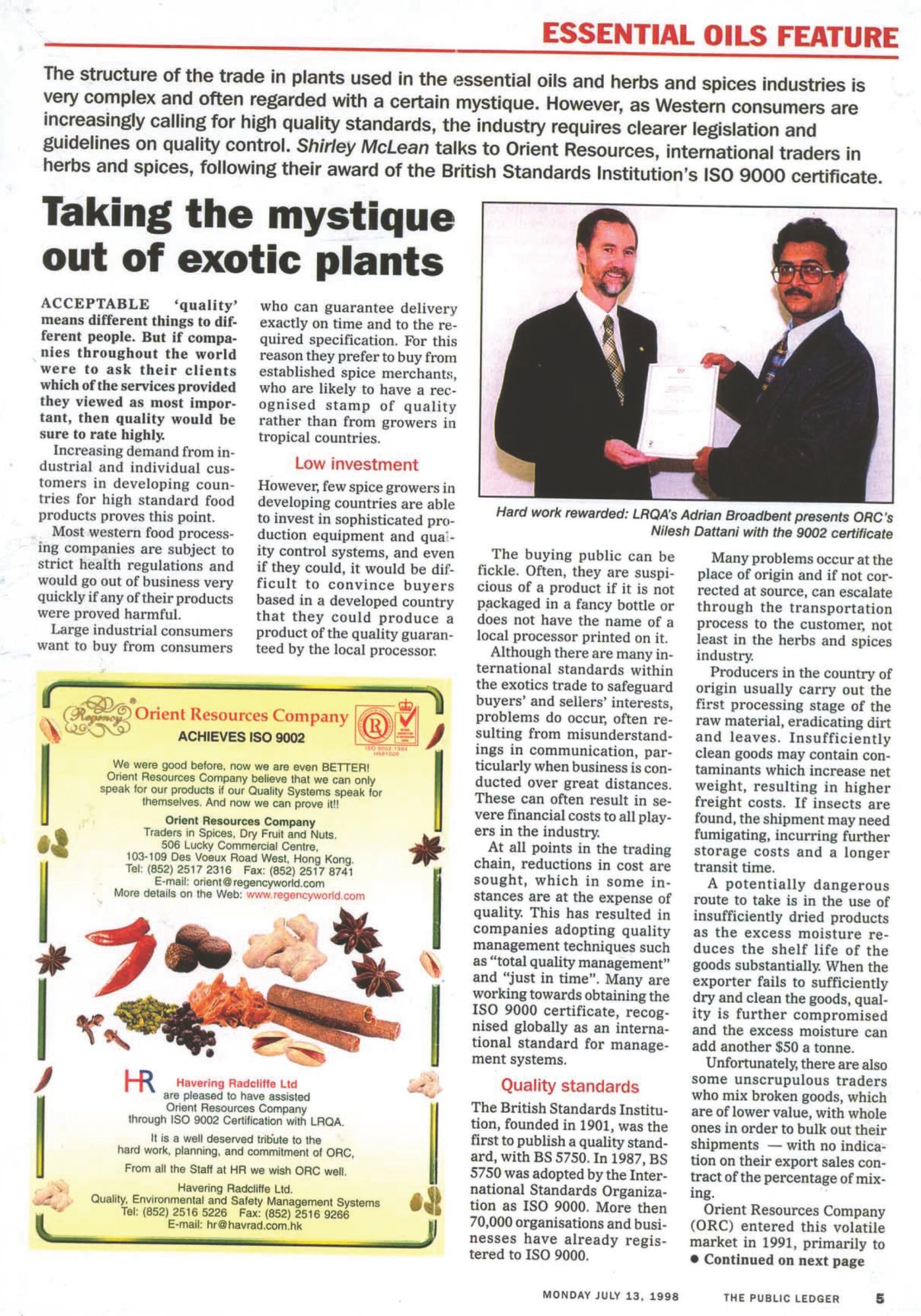
In July 1998, China Business Limited received its first ISO 9001 certificate from Lloyd's Register Quality Assurance (LRQA) — one of the world's most respected certification bodies. The achievement was reported in The Public Ledger, the commodity trade journal published continuously since 1760. We have maintained unbroken ISO certification ever since, evolving from ISO 9001 to the food-safety-specific ISO 22000 standard.
Four layers. All of them matter.
In our product categories, quality is not a single thing. It operates on four distinct levels — and a supplier who passes on one can fail on another. Our verification process covers all four. We didn't build these standards in a boardroom. We built them from direct experience of what happens when they're absent.
Colour, appearance, aroma, taste, moisture content, and visual grade. These are the qualities most buyers check first — and which unscrupulous suppliers learn to manipulate for samples while compromising on bulk shipments. We verify bulk production, not just samples.
Volatile oil content in cassia. Allicin levels in dehydrated garlic. Gel strength in AgarAgar. These internal parameters determine functional performance in food manufacturing — and they are most commonly misrepresented in documentation. We require and verify laboratory test results against the actual shipment, not a reference sample.
Pesticide residues, heavy metal levels, microbial counts, ETO contamination, allergen declarations, coumarin content in cassia, lead levels — the list of regulatory parameters for food ingredients entering the UK and EU is extensive and changes regularly. We track these requirements and ensure supplier documentation is current, accurate, and relevant to your specific market.
Certifications expire. Lab reports reference wrong batches. Organic certificates cover different farms than the one that packed your shipment. We review the documentation chain critically — not as a formality, but because we have seen every variation of documentation fraud in three decades of working in this market.
"We don't just verify that a certificate exists. We verify that the reality behind the certificate matches what it claims."
Verification is a pattern, not a moment
The food ingredient industry relies heavily on one-time checks — a certificate, a lab report, a single audit visit. These have value, but they have limits. Our approach is built on continuity: ongoing observation of the same suppliers across seasons and shipments, so we identify patterns rather than snapshots.
Unannounced factory visits
We visit without pre-notice so you see normal operations — not a prepared showroom. Factory audits are unannounced by design. Pre-shipment inspections are scheduled by necessity (goods must be ready). We are clear about the distinction.
Practical process audits
We focus on what's actually being produced, not what's written on the wall. Production conditions, staffing, hygiene, storage, batch handling — observed in normal operation, not under audit conditions.
Cross-shipment verification
We track quality across multiple shipments — not just the first sample sent for approval. Quality shortfalls in bulk after approved samples is one of the most common problems in this market. We monitor for it.
Documentation chain review
Certificates, lab reports, organic declarations, origin documentation — reviewed critically, not as a formality. We match documents to actual shipments and flag inconsistencies before they become your problem.
Every factory assessment concludes with one of three verdicts — stated plainly, in writing. No softening, no ambiguity, no agenda.
What we can honestly say — and what we cannot
Sustainability matters to us. It also matters increasingly to our clients, to regulators, and to the food supply chain as a whole. The EU's Corporate Sustainability Due Diligence Directive, supply chain transparency legislation in the UK and Germany, and shifting regulatory requirements are all moving in one direction. We want to be straightforward about our current position — because straightforwardness is more useful than a policy that looks impressive on paper but cannot be substantiated in practice.
As a broker and agent, CBL's direct environmental footprint is limited. We do not operate factories, control packaging lines, or manage logistics. What we can do — and do — is incorporate sustainability criteria into how we evaluate and select suppliers.
- We ask suppliers about their environmental certifications and practices as part of our vetting process.
- We flag to clients where a supplier's practices fall short of what their own customers or regulators may require.
- We will not represent suppliers whose labour practices or environmental record present reputational risk to our clients.
- Our ISO 22000 framework includes ethical trading values and labour rights commitments that apply to our supply chain relationships.
We are in the process of formally incorporating sustainability criteria into our ISO 22000 quality management framework. When that work is complete, our sustainability commitments will be documented, audited, and verifiable — not just stated. Until then, we prefer to describe what we actually do rather than commit to targets we cannot yet measure.
Our supplier vetting process requires, at minimum, compliance with the labour rights, environmental, and food safety standards applicable in the buyer's destination market. For UK and EU buyers, this increasingly means alignment with EU deforestation regulations, supply chain due diligence requirements, and pesticide and contaminant standards that go beyond Chinese domestic requirements. We make these expectations explicit in our supplier relationships.
We recognise this is an area where expectations are rising faster than many suppliers — and some agents — are moving. We would rather acknowledge that gap honestly than paper over it with commitments we cannot substantiate.
Questions about our standards?
Start with a conversation.
If you have specific quality requirements, regulatory concerns, or sustainability obligations for your market — tell us. We'll give you an honest assessment of what we can deliver.